

Making Space # 3
Gathered threads; the meaning of Kumihimo, not lost in translation.

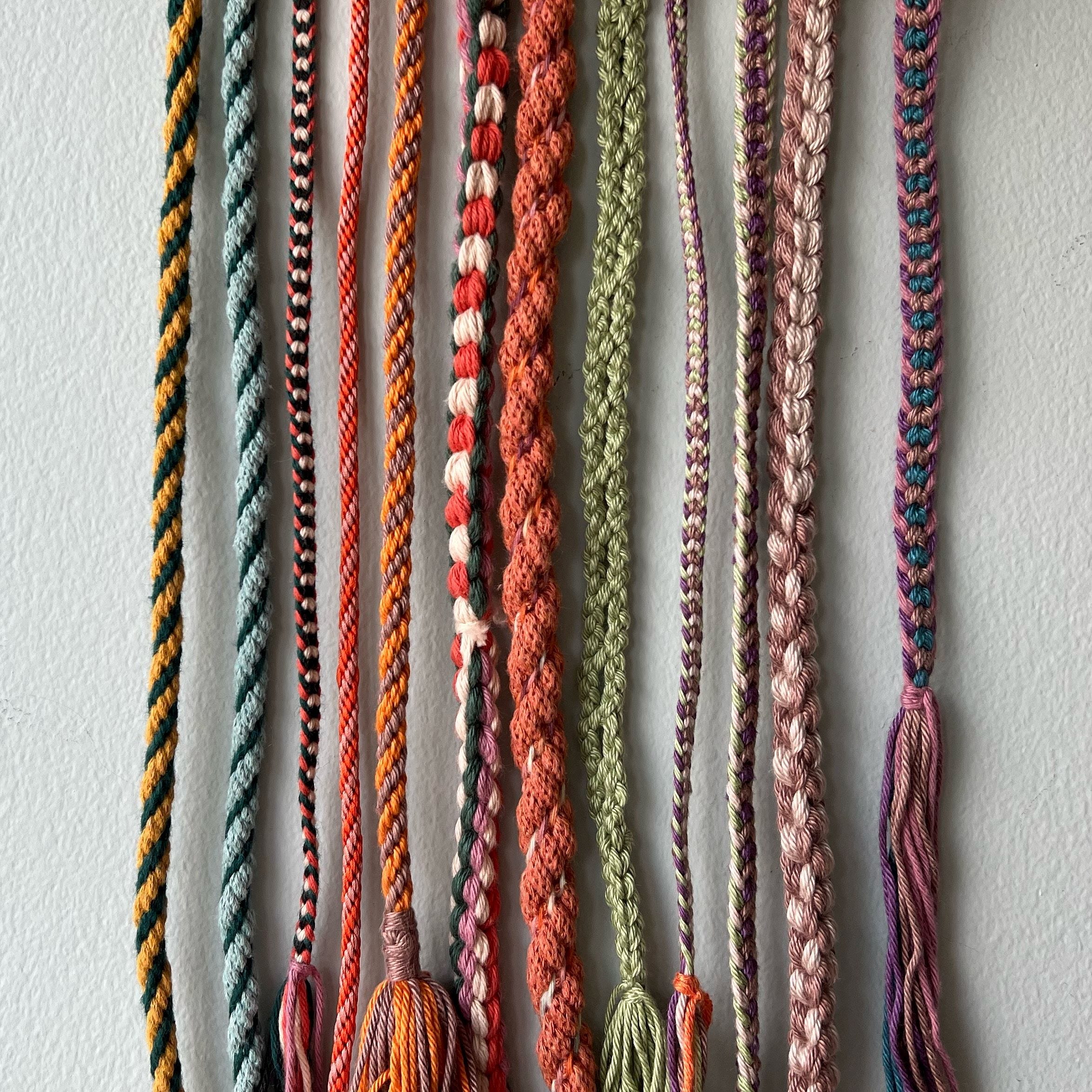
Dear reader, it’s been a while…
At the beginning of this year I set a goal; to document my process in learning the heritage craft skills of Passementerie, Kumihimo and Ply-split Braiding. Not only a personal goal, but a stipulation of the training bursary I was awarded from the Heritage Crafts Association, which has made this specialised training possible. So far I have undertaken two out of three 1:1 sessions and attended 1 course in West Dean, all under the tutelage of three distinctly talented and incredibly knowledgeable craftswomen.
Being a student has required a great shift in perspective; opening myself up to absorb huge amounts of new information, putting aside all that I think I know, accepting failures and feeling well out of my comfort zone. It’s similar to that feeling of starting a new job or project, you know you can do it, but the unfamiliar space breeds doubt and only time and practice will bring confidence in your abilities. It’s exciting and exhausting all at the same time. Meanwhile the busy responsibilities of life are still waiting for me when I arrive home. To sustain this transitional pace I’ve had to embrace an intentional sloth mode and resist the urge to beat myself up about my lack of output. I remind myself that this opportunity deserves the space, the attention and the permission to take it all in and just enjoy the process.
What I have learned and experienced along the way has been mind blowing; a journey that has instilled me with deep appreciation and an acute awareness of the balance between input and output, forces that ebb and flow through my finite pool of creative energy like a tide. It’s overwhelming at the best of times. I’ve been across the Irish Sea three times now this year and while I am grateful for every minute immersed in these new experiences, there is no greater feeling then returning home to the comfort of family, and my own sweet bed.
So with all that in mind, I won’t get caught up on the fact that since my last update the bleak skies of February have transformed into the lush green wave of May…

…instead I’ll just go ahead and share the incredible things I’ve been up to since then.
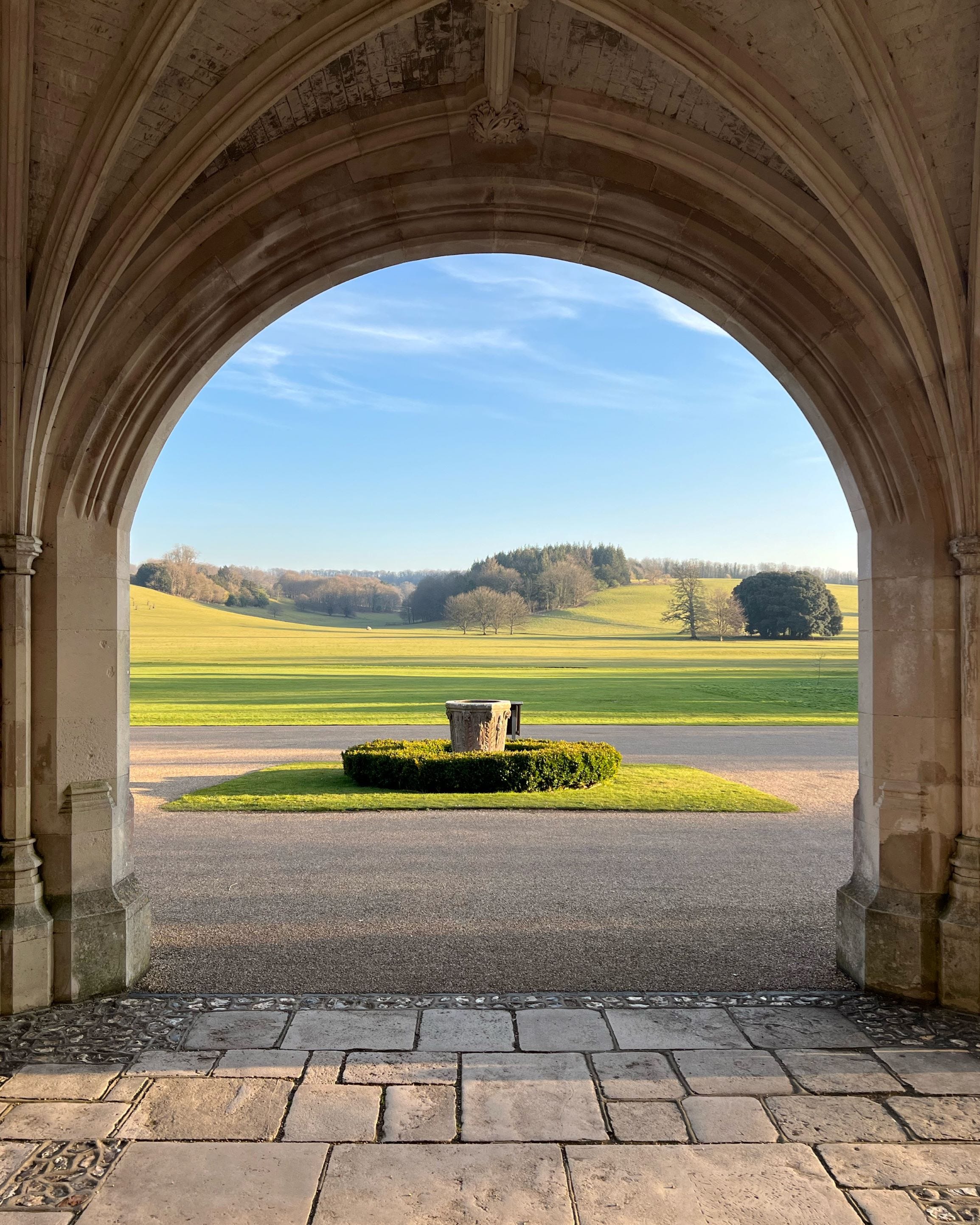
March 2025 ~ Kumihimo ~ West Dean
It was a glorious sunny day when I arrived on the West Dean Sussex campus on the third day of March, at least that’s how I remember it. Thankfully I recorded a few notes in my journal to prompt my less than perfect memory, because it’s the little details that are so important. I checked in a day early and was looking forward to wandering the grounds and spending some time in the library before my course was due to start. The West Dean Estate is a magical place, located a few miles north of Chichester England, covering 6,200 acres situated entirely within the South Downs National Park. Originally a very (very) grand family home, West Dean was transformed into a centre for education and creativity by visionary patron of the arts, Edward James in 1971. It’s an ideal place for a residency, and my second visit, so I knew I was in for a week of nourishment, nature and of course some new skills.
The course I was there to attend was Kumihimo (Japanese Braidmaking) with Jacqui Carey. This is not the braid making you might see advertised as kumihimo in craft shops or online, selling those little foam discs with all the numbered notches. This is the traditional Japanese practice of kumihimo. As I come to discover there’s a huge difference. Firstly traditional kumihimo is made using a braiding table, of which there are different types including marudai, kakudai, ayatakedai and takadai. For this course I have come prepared with a lovely wooden marudai that I sourced second hand through The Braid Society, on Jacqui’s recommendation. It’s a simple design consisting of a round top surface with a central hole, supported by four legs connected to a base. The round top surface is known as the kagami which translates to mirror. Not only does this allude to a smooth surface, an important factor for braid making on a marudai, but also introduces the ritual element of the practice and the saying, as Jacqui explains, “the braid is a reflection of the braid-maker”.
It’s a practice steeped in Japanese culture: a technique that is believed to have been introduced from ancient China. For over a millennia this artform has evolved and developed, innovated by dedicated craftspeople through each era to create decorative cords for scrolls, samurai swords and armour, ceremonial teaware and kimono. It’s a rich history that deserves more than a passing mention. I recommend reading about it in more detail on the Domyo website, a 10th generation kumihimo workshop/store/archive in Tokyo, established in 1652 and keeping the traditional practice alive ever since.
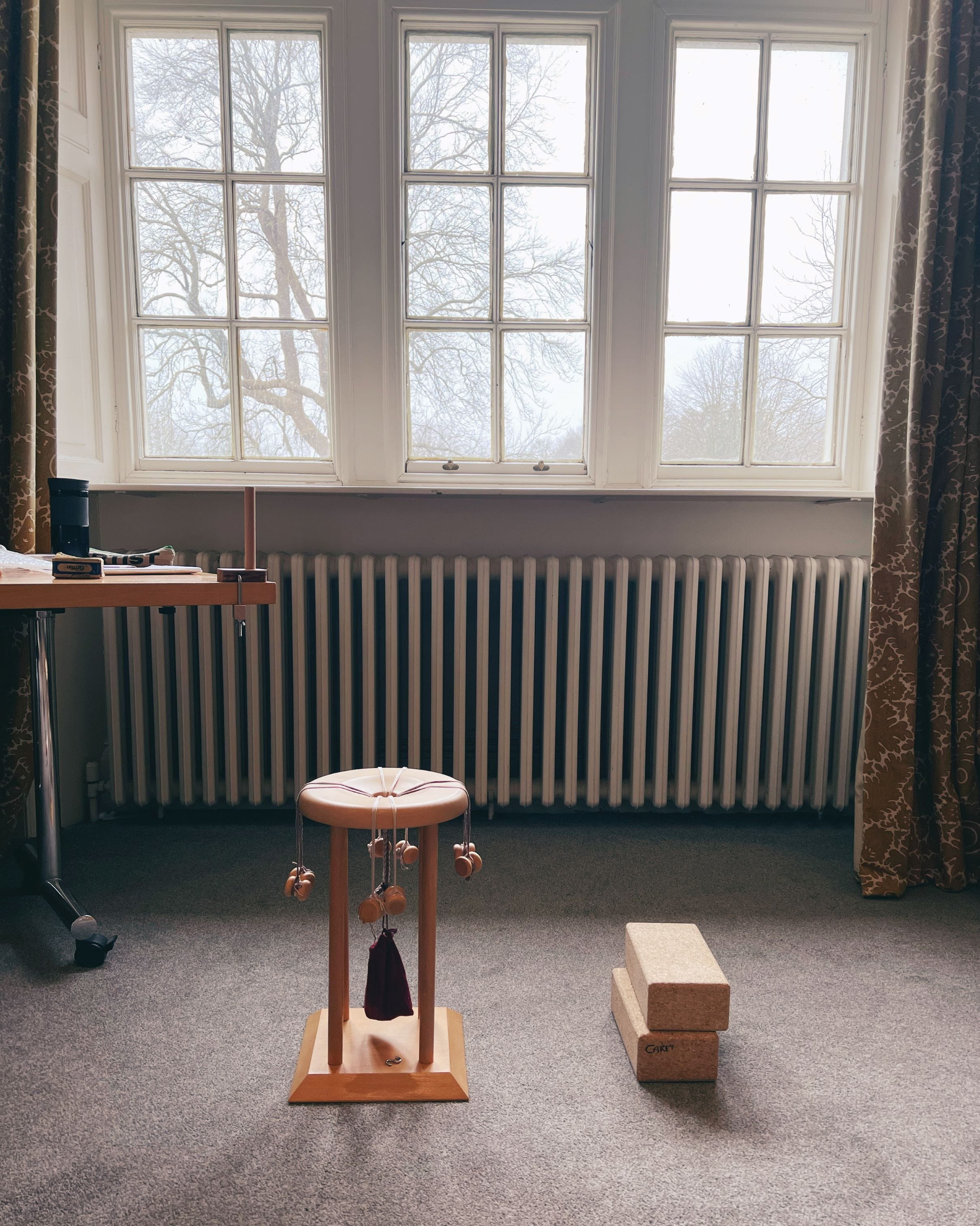
The course group is small and our tutor Jacqui generously shares her knowledge with a calm and steady patience. It feels like discovering the tip of an iceberg, it also starts to feel like we’ve started a yoga or meditation session. After walking us through the process of loading up thread onto each spool, or kumidama, she invites us to place ourselves in the traditional seated position, seiza. With the help of a few cork yoga blocks (to keep my feet from going numb) I sit myself on the floor facing the marudai. Next we are asked to consider our position. As my marudai is made from wood, Jacqui suggests I line up the natural grain like the directions of a compass; north, east, south, west. It’s a grounding and embodied ritual, encouraging us to be intentional in what we are about to create. It’s also a very practical way to keep track of the order of the braid.
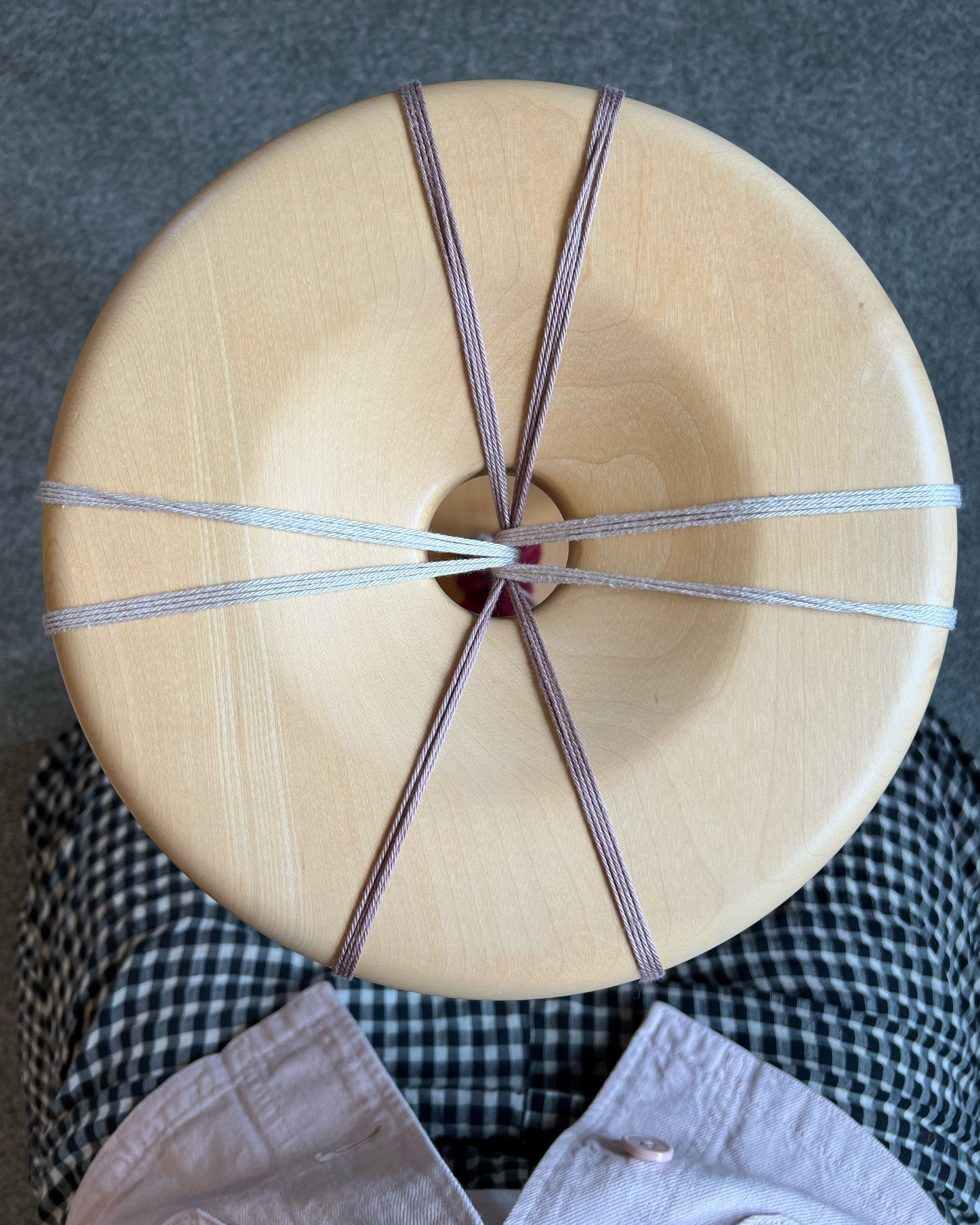
Down through the hole of the marudai, the threads are secured with a small weighted bag and held in place by a chopstick. Each spool gently dangles over the rounded edge of the marudai like a yo yo. I opt to start with an 8 spool pattern, more complex designs can be made with 16 or 24 kumidama, but I’d like to play it safe and get the hang of it first. The braiding begins, a precise sequence of repeating gestures with hands fixed in an exact position, thread held between fingers and thumb, a simultaneous movement of 2 bobbins to a new position. The threads converge and cross over one another through the central hole, forming "the point of braid”. Each fluid movement a consideration, being sure to lift the thread from a point above the bobbin but below the marudai surface, holding the thread tension just right so as not to interrupt the flow and end up with an untidy braid. North and west threads are lifted with the thumb, south and east threads lifted with four fingers. Jacqui demonstrates, her movements flow like a dance, in time with the muted rhythm of spools gently knocking against one another. At this point I’m glad of the decision to start with an 8 spool pattern and spend most of the first day getting used to the FEEL of the process.
Over the course of three days I am introduced to the seemingly endless possibilities of pattern and structure. Each intricate variation feels distinctly different, each sequence of movements creates a unique braid. Add into the mix the use of colour, varying thread thickness and changes in weight and tension and you end up with something that starts to parallel the theory of general relativity, as if my “point of braid” has the power to becomes a porthole to infinite realities. It’s an exciting prospect, fuelled by my desire for greater creative autonomy in my use of materials and process. I’m still in the very early stages, an eager student percolating the knowledge I have gained so far, waiting for the moment when it all converges, coming together like gathered threads; the meaning of kumihimo, not lost in translation.
Thanks for taking the time to read this post. Next up I will be sharing my experience of learning the art of ply-split braiding with Julie Hedges so please stay tuned or subscribe to get it straight to your inbox. Alison x
Alison, this is a gorgeous read! The whole piece reads like a meditation as I imagine the crafting of threads was. So calming and soothing. Fascinating to learn about your creative journey and this creative practice on your retreat. Thanks so much for sharing about it all with us here x
Sounds like a fascinating experience...also love intentional sloth mode... 🦥 ✨